
No. Many of the findings that appear on an MRI — disc bulges, wear, desiccation — are equally common in people with no pain at all. An imaging finding becomes relevant only when it fits the clinical story, the physical examination and what is actually limiting you.
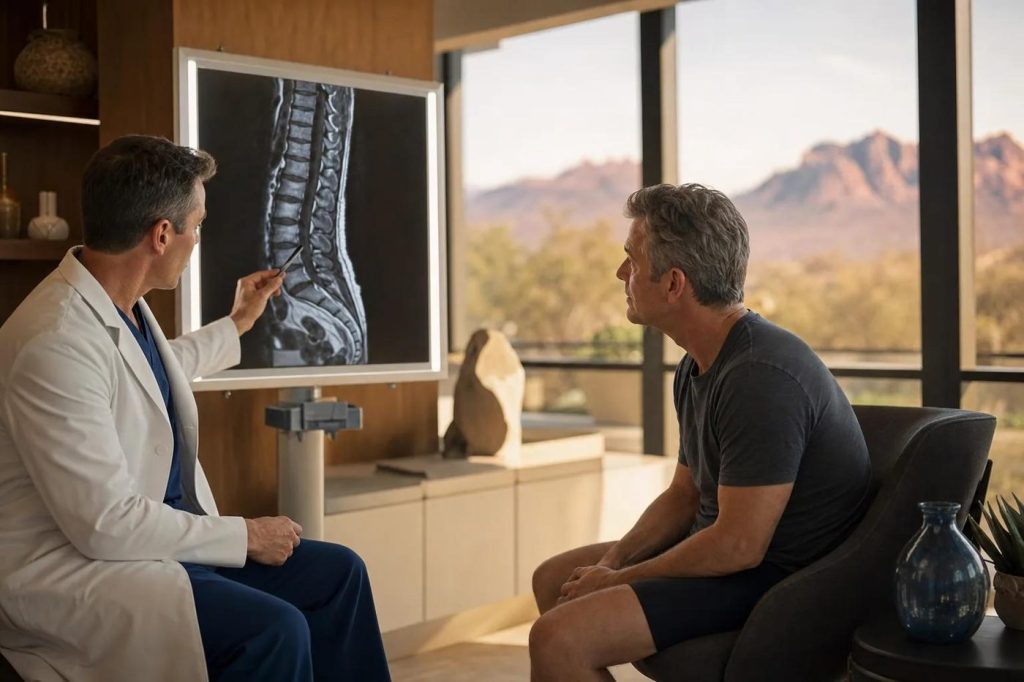
Imaging findings are common without pain
Many of us have an MRI because of back or neck pain and discover a disc bulge, a herniation or degenerative change. The finding feels like an answer — at last, something visible.
But a scan of anyone over forty will almost always show something. Findings like these appear at high rates in people with no pain at all, so their existence alone does not prove they are the source of the problem.
The right question
The difference between “what does the MRI show” and “is what the MRI shows the thing that hurts” is the difference between treatment aimed at the right place and a successful treatment in the wrong place.
Answering the second question takes three things together:
- The clinical story. When the pain worsens, what eases it, how it behaves through the day.
- The physical examination. Movement, sensation, strength, and targeted tests for the suspected structures.
- The imaging. Not as the single source of truth, but as a layer that either fits the other two or does not.
When all three point to the same place, the diagnosis is strong. When they diverge, that is exactly the moment to stop and look further rather than start treating.
What this looks like in practice
This is the first pillar of SAADA METHOD: precise diagnosis before precise treatment. Where several plausible sources remain and telling them apart would change the treatment, a targeted diagnostic block can be performed — an injection whose purpose is to confirm or exclude one source before treating it.
We treat the person, not only the picture.
Low back pain — what else the source could be ←
Frequently asked questions
Then why have an MRI at all?
To see the map of possibilities and to rule out conditions that need urgent treatment. Imaging is excellent at answering "what is there", but on its own it does not answer "what hurts".
I have a large disc herniation. Is that necessarily the source?
Not necessarily. If the symptoms match the nerve root the herniation is pressing on, it probably is. If the pain map points somewhere else, the herniation may be an incidental finding.
What should I bring to the diagnostic appointment?
The imaging disc or file itself (not only the radiologist's report), a list of the treatments already tried and what happened after each, and your current medication list.
